Abstract
Advances in video generation and avatar synthesis enable new ways to answer user questions through visual explanations. This task requires a system to formulate a correct answer, translate relevant information into visual material, and deliver the explanation through an avatar's speech and actions. Existing benchmarks rarely assess whether avatars point to the visual content being discussed. We introduce VisualTalk-Bench for question-driven avatar-led video explanations in finance and Chinese and English education. It includes 800 curated reference videos and 100 independent evaluation requests, assessing Content Factuality, Speech–Visual Consistency, Visual Quality, Motion Smoothness, and Avatar–Content Pointing. Experiments across six complete agents show that factual precision and visual quality do not guarantee accurate pointing. A 26-participant study comparing four agents finds that Avatar-O Agent receives the highest average ratings for visual guidance, perceived pointing accuracy, and explanation effectiveness. The dataset and code are planned for release.
Why pointing matters
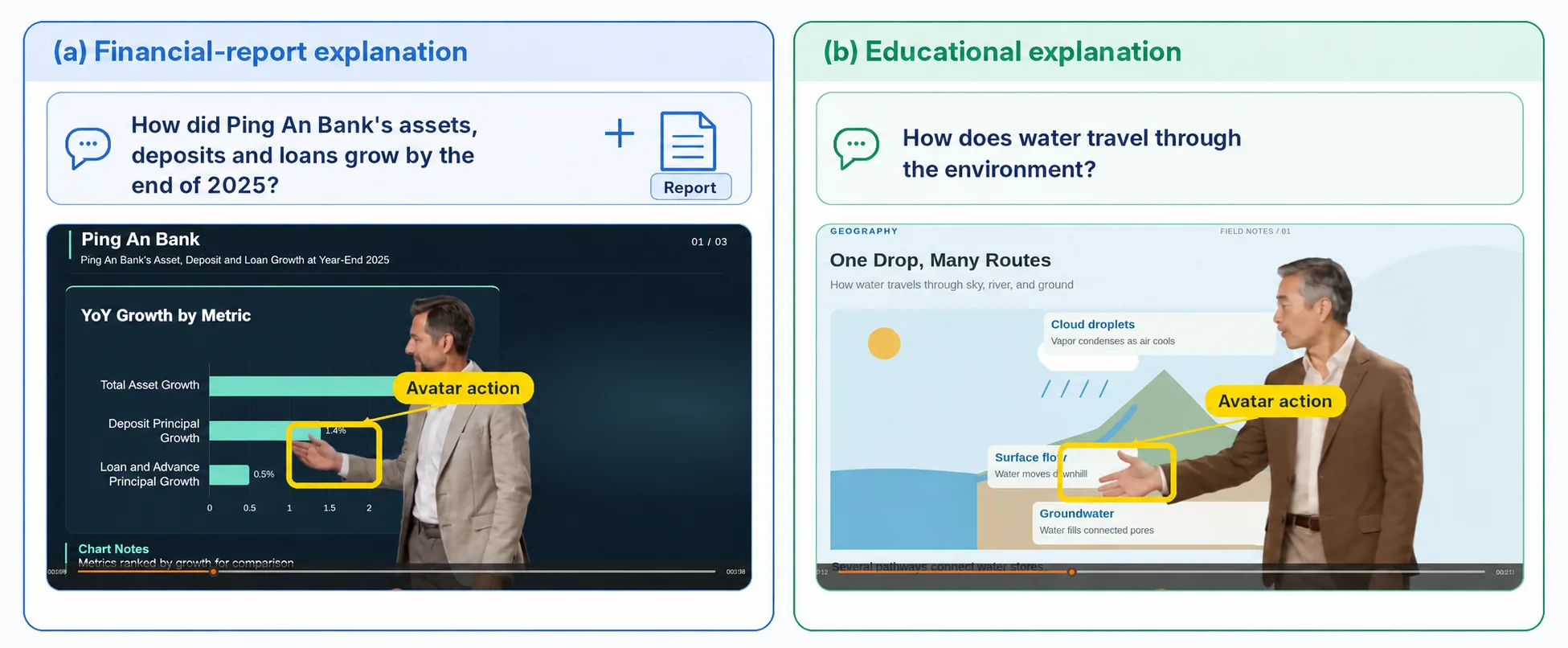
An explanation may contain a correct statement and an accurate chart while the presenter's gesture indicates the wrong region. VisualTalk-Bench evaluates the observed gesture in the final video relative to the visual element referenced in speech; generation-time target boxes are not used as evaluation evidence.
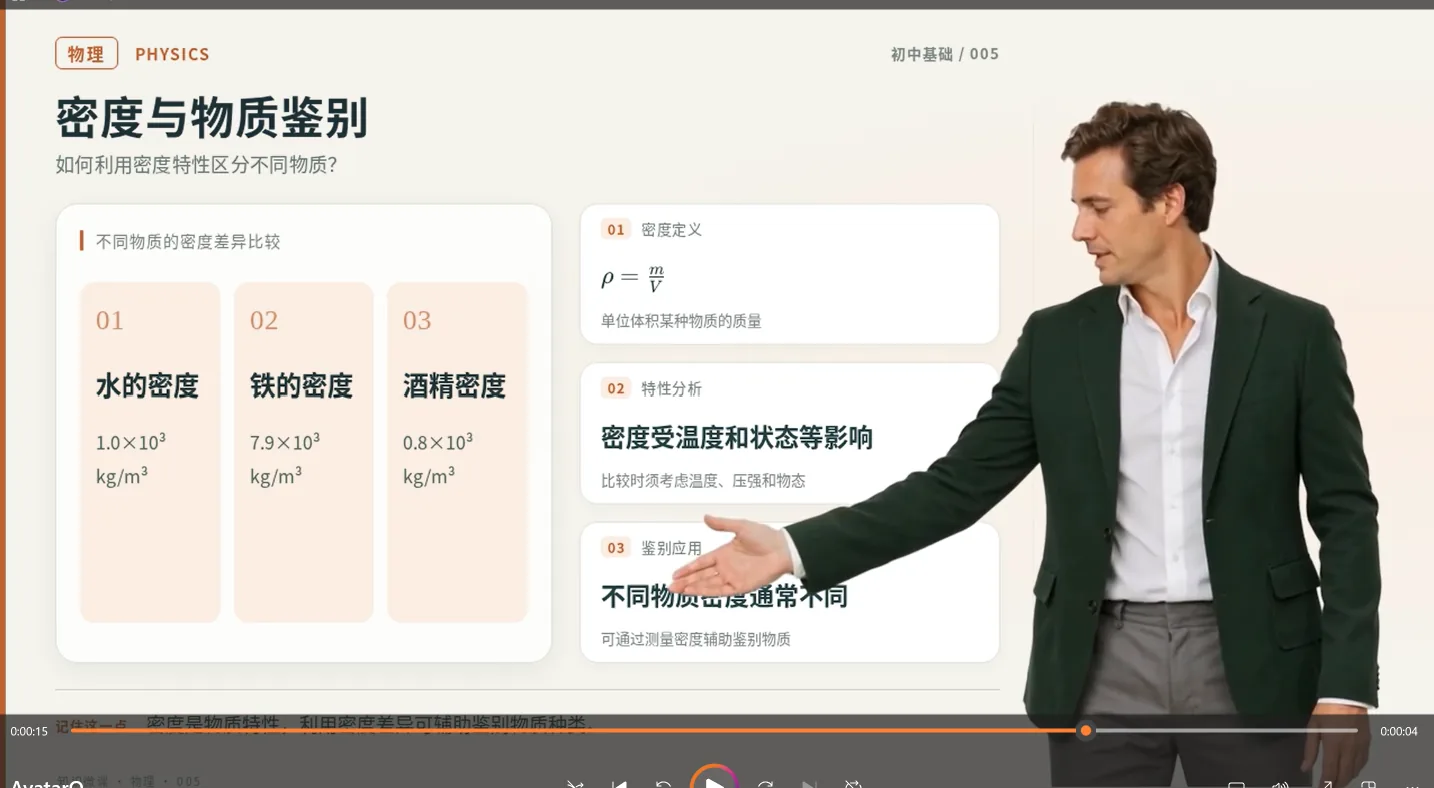
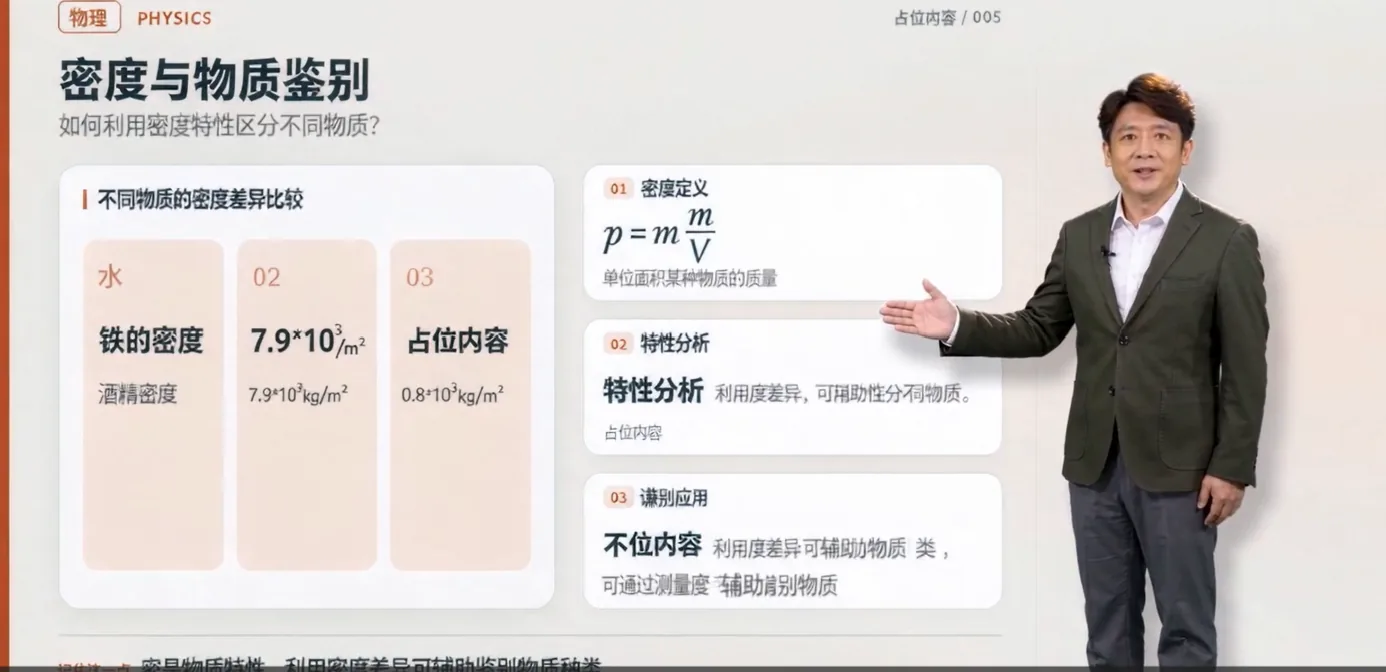
Yellow outlines indicate the intended visual targets. These are illustrative examples, not additional quantitative results.
Dataset
VisualTalk-Bench contains 800 curated reference-video examples in three domains. A separate set of 100 evaluation requests is constructed independently for comparing complete question-to-video agents. Financial requests contain three ordered scenes; educational requests contain one.
| Domain | Reference examples | Evaluation requests |
|---|---|---|
| Finance | 300 | 20 |
| Chinese education | 300 | 40 |
| English education | 200 | 40 |
| Total | 800 | 100 |
Reference videos are excluded from system performance statistics. The reference set and evaluation requests are not a train/test split carved from one collection.
Evaluation protocol
We evaluate five complementary dimensions independently rather than combining them into one score.
Avatar-O Agent
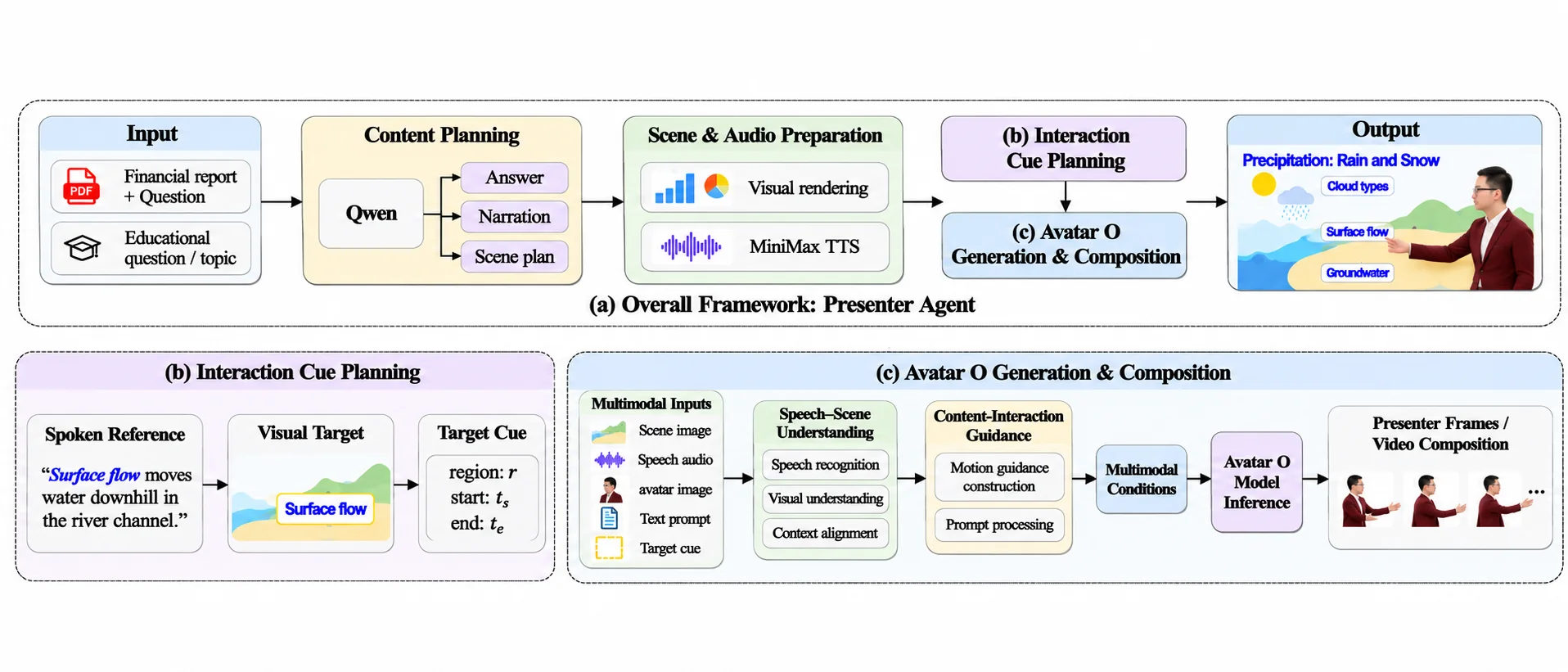
We implement an agent that plans the answer, prepares narration and visual materials, connects spoken references to rendered targets, and synthesizes the avatar-led explanation. It serves as a reference realization of the task; the benchmark itself is architecture-agnostic.
Quantitative results
The following values are the agent-level results reported in the paper. Each row represents a complete task-to-video agent, not an isolated video-generation model.
Scroll the table horizontally to see all metrics.
| Agent | Speech factuality ↑ | Visual factuality ↑ | Speech–visual ↑ | Visual quality ↑ | Jerk ↓ | Pointing accuracy ↑ | Pointing rate ↑ |
|---|
All scores except jerk are on a 0–100 scale. Pointing Accuracy is N/A when there are no assessable directed gestures; this is different from a Pointing Rate of 0.00. Lower jerk does not necessarily imply better pointing or guidance.
Selected reference videos
Twelve selected reference scenes illustrate the three dataset domains (four per domain). They are examples from the curated reference corpus, not the six-agent comparison set. Financial clips are individual scenes rather than complete three-scene answers.
Citation and resources
Read the paper on arXiv. Benchmark implementation and dataset download links are planned for release.
@misc{zhang2026visualtalkbench,
  title={VisualTalk-Bench: Evaluating Question-Driven Avatar-Led Video Explanations},
  author={Xin Zhang and Tujie Xu and Zhiyi Chen and Xiaodong Zhang and Sicheng Yang and Minglei Li},
  year={2026},
  eprint={2611.25444},
  archivePrefix={arXiv},
  primaryClass={cs.CV},
  url={https://arxiv.org/abs/2611.25444}
}